
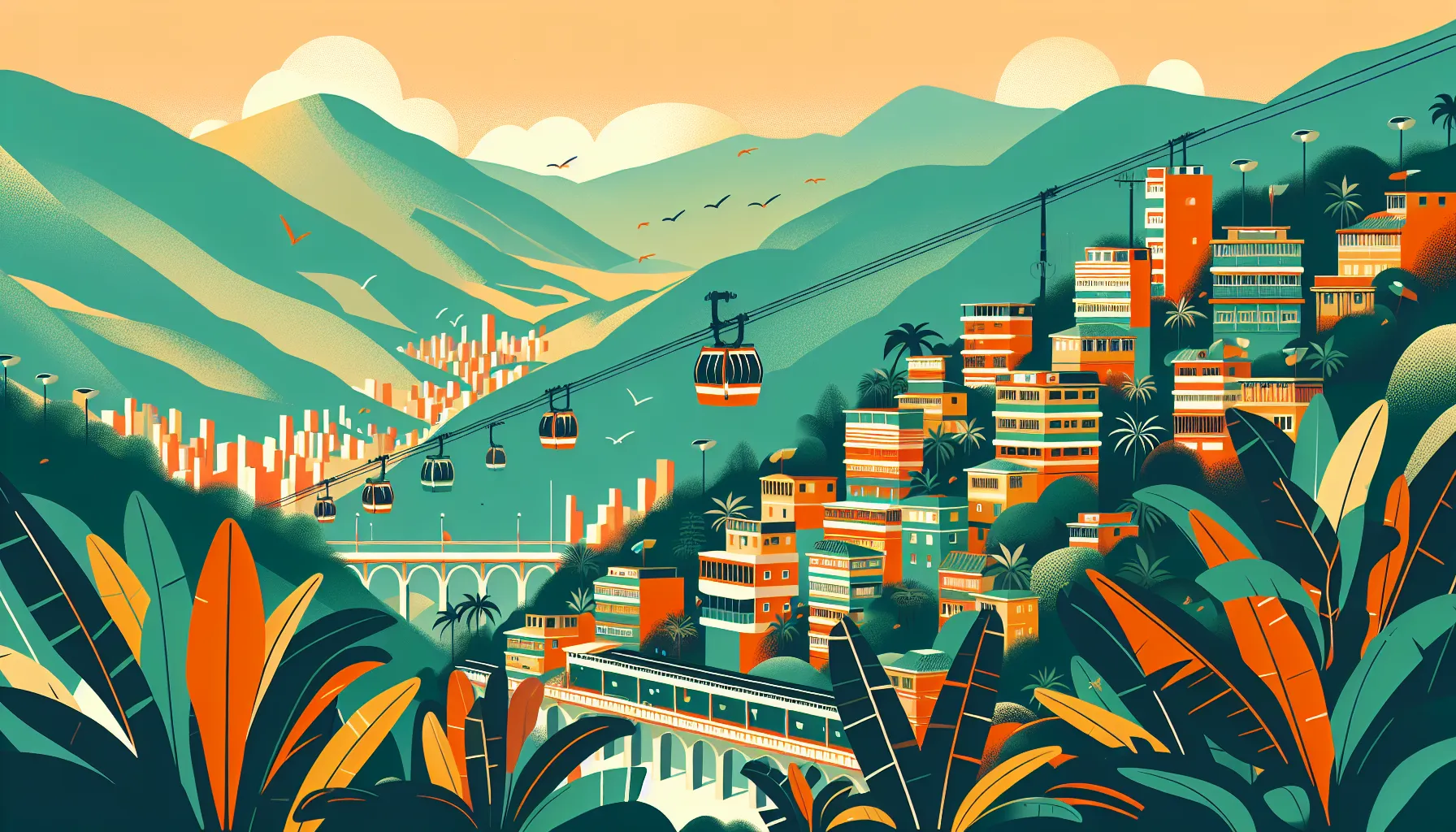
Medellín’s Metrocable: How Cable Cars Connected a Divided City
Medellín’s Line K Metrocable opened on 7 August 2004, connecting the hillside barrios of the northeast to the Acevedo Metro station (Metro de Medellín). Within five years, job accessibility in the corridor it serves had doubled — from 0.33 to 0.62 jobs per working-age individual (Bocarejo et al., 2014, Journal of Transport Geography). The system now runs six lines across 20 stations and 14.62 km.
The network, line by line
| Line | Opened | Connects | Area served |
|---|---|---|---|
| K | 7 Aug 2004 | Acevedo – Santo Domingo | Northeast |
| J | 3 Mar 2008 | San Javier – La Aurora | West (Comuna 13 / San Javier) |
| L (Cable Arví) | Feb 2010 | Santo Domingo – Arví | Near east — tourist line, separate fare |
| H | 17 Dec 2016 | Oriente – Las Torres – Villa Sierra | Comuna 8, east |
| M | 2019 | Miraflores – Trece de Noviembre | Centre-east |
| P (Picacho) | 10 Jun 2021 | Acevedo – Sena – Doce de Octubre – El Progreso | Northwest, comunas 5 and 6 |
Source: Metro de Medellín, Línea P.
Two points worth being precise about, because they are widely misreported: Line H serves Comuna 8 (Villa Sierra), not Comuna 13 — the line nearest Comuna 13 and its outdoor escalators is Line J, via San Javier. And it is Line L, not Line P, that reaches Parque Arví; Line P runs northwest to Picacho.
A City Split by Geography
Medellín sits in the narrow Aburrá Valley, hemmed in by mountains on all sides. For decades the wealthiest neighbourhoods occupied the flat valley floor while lower-income residents built homes on the steep hillsides above. The horizontal distance was short, but the commute was long and expensive on crowded, winding buses — which locked people out of jobs, education and city life.
That is the problem the Metrocable was built to solve, and it is the reason researchers treat it as a mobility-and-equity intervention rather than a transport project.
Line K and what it changed
Line K opened on 7 August 2004 as part of Mayor Sergio Fajardo’s Social Urbanism programme (2004–2007), the principle that public investment should flow first to the most marginalised areas. Alongside the cable lines, the city built library parks, schools, public plazas and sports facilities in the same hillside neighbourhoods.
The effects have been measured repeatedly:
- Job access doubled. Accessibility in the served corridor rose from 0.33 to 0.62 jobs per working-age individual in five years (Bocarejo et al., 2014).
- Homicide fell faster than in comparable areas. A natural experiment comparing 25 intervention against 23 control neighbourhoods, with 466 residents surveyed, found the homicide decline was 66% greater in intervention neighbourhoods (rate ratio 0.33, 95% CI 0.18–0.61) between a 2003 baseline and 2008 (Cerdá et al., 2012, American Journal of Epidemiology).
- Residents reported less violence. Resident reports of violence fell 75% more in intervention neighbourhoods than in control neighbourhoods (odds ratio 0.25, 95% CI 0.11–0.67) — a relative difference, not an absolute 75% drop (Cerdá et al., 2012).
- The change was psychological as well as physical. Research in Springer’s Urban Transformations identifies the Metrocable’s 2004 inauguration as the turning point in the city’s reputation, with its transformative impact rooted in residents’ own perceptions of inclusion and integration (Galvin & Maassen, 2020). Brand and Dávila likewise found the cable cars raised community pride and self-esteem among formerly marginalised residents (Brand & Dávila, 2011, City).
Riding the Metrocable as a Visitor
Fares changed on 10 January 2026. The standard Cívica fare is 3,820 COP for the Frecuente profile, 4,400 COP for the Eventual/tourist profile, 1,600 COP student and 3,330 COP older adult (Metro de Medellín tariffs 2026). The average increase across metro, tram, cables and Metroplús was 12.1%.
One caveat the guides usually miss: lines K, J, H, M and P are integrated into the ordinary Metro fare, but Line L (Cable Arví) is a tourist line with its own separate, higher fare. Residents in estratos 1, 2 and 3 pay 75% less on it (Metro de Medellín).
- Line K to Santo Domingo is the most popular tourist route. From Acevedo you glide over densely packed hillside barrios with views across the valley. At the top are the Parque Biblioteca España and Santo Domingo park.
- Line L to Parque Arví runs 4.8 km from Santo Domingo over the ridge, reaching Arví in 14 minutes. The park protects 1,761 hectares of native and planted forest; the wider Arví area extends across the municipalities of Envigado, Bello, Copacabana and Guarne. The line has carried 9 million+ tourists in its first decade (Metro de Medellín).
- Line J serves San Javier, the gateway to Comuna 13 and its outdoor escalators.
A Global Model
Medellín’s Metrocable has been studied and replicated widely, with urban cable systems built in La Paz, Rio de Janeiro, Caracas and elsewhere.
A review in Transport Reviews concluded that cable cars alone do not solve poverty — complementary social projects are essential — but that the travel-time and cost reductions they deliver meaningfully increase accessibility for the residents who need it most (Transport Reviews, 2023). Later work has examined the relationship between Metrocable expansion and informal housing dynamics (Transport Policy, 2022), and UCL’s Development Planning Unit has published a book-length treatment of mobility and poverty across Medellín and Soacha (Dávila, 2013, UCL DPU).
The Metrocable is more than a ride. It is a thesis statement: that a city’s most powerful infrastructure is not highways or airports, but the connections it builds between its own people.
References:
-
Bocarejo, J.P. et al. (2014). “An innovative transit system and its impact on low income users: the case of the Metrocable in Medellín.” Journal of Transport Geography, 39, 49–61. ScienceDirect
-
Brand, P. & Dávila, J. (2011). “Mobility innovation at the urban margins: Medellín’s Metrocables.” City, 15(6), 647–661. Taylor & Francis
-
Galvin, M. & Maassen, A. (2020). “Connecting formal and informal spaces: a long-term and multi-level view of Medellín’s Metrocable.” Urban Transformations, Springer Nature. Springer
-
Cerdá, M. et al. (2012). “Reducing Violence by Transforming Neighborhoods: A Natural Experiment in Medellín, Colombia.” American Journal of Epidemiology, 175(10), 1045–1053. Oxford Academic
-
(2023). “Aerial cable cars as a transit mode: a review.” Transport Reviews. Taylor & Francis
-
(2022). “Transit infrastructure and informal housing: Assessing an expansion of Medellín’s Metrocable system.” Transport Policy. ScienceDirect
-
Dávila, J. (ed.) (2013). “Urban Mobility and Poverty: Lessons from Medellín and Soacha, Colombia.” Development Planning Unit, UCL. UCL Bartlett DPU
-
“History of the Medellín Metro System.” Metro de Medellín. Metro de Medellín
-
“Línea P.” Metro de Medellín. Metro de Medellín
-
“Estratos 1, 2 y 3 pagarán 75% menos por viajar en el Metrocable turístico Arví.” Metro de Medellín. Metro de Medellín
-
“Más de 9 millones de turistas han viajado en el Cable Arví.” Metro de Medellín. Metro de Medellín
-
“Tarifas Metro de Medellín 2026.” Metro Medellín