
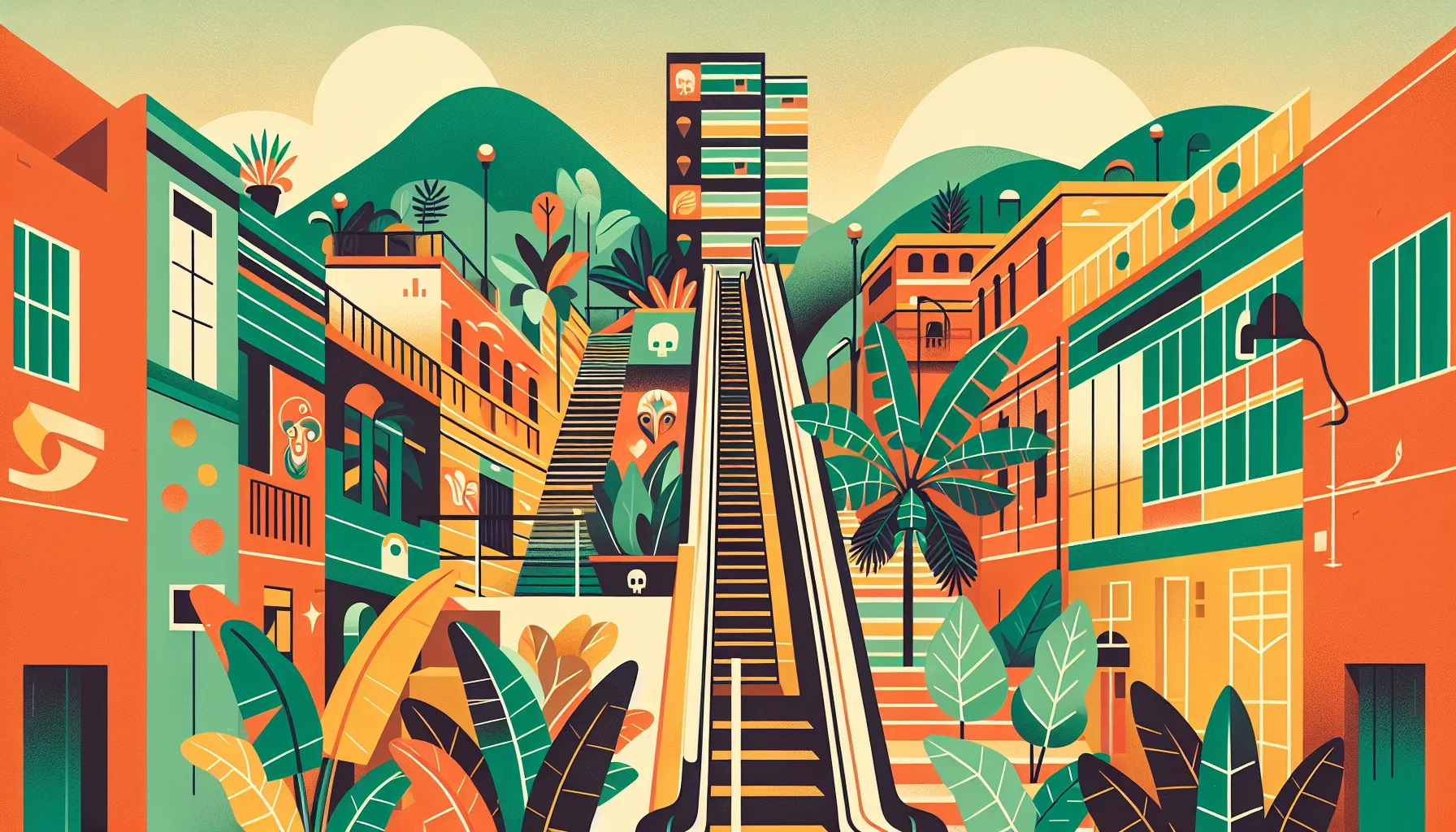
Comuna 13: From Conflict Zone to Open-Air Art Gallery
Comuna 13 (officially San Javier) is now one of the most photographed neighbourhoods in South America — murals, street performers, hip-hop dancers and shops cascading down a steep hillside. The story behind the colours is anything but superficial. In October 2002 a military operation here left 600+ direct victims, including 105 people forcibly disappeared (Centro Nacional de Memoria Histórica). Nine years later, six outdoor escalators covering 384 metres replaced the 350 concrete steps residents had climbed daily (Alcaldía de Medellín).
The numbers, at a glance
| Figure | Value | Source |
|---|---|---|
| Operación Orión | 16–17 October 2002; armed intervention continued into December | CNMH |
| Direct victims | 600+ (detained, displaced, injured, killed, disappeared) | CNMH |
| Forcibly disappeared | 105 | CNMH |
| Killed by paramilitaries / state forces | 71 / 17 | CNMH |
| Civilians injured | 80 | CNMH |
| JEP victim list, Comuna 13 (1978–2016) | 417 forced disappearances | El Espectador |
| Escalators inaugurated | 23 December 2011 | Alcaldía de Medellín |
| Escalator length / sections | 384 m, six sections | Alcaldía de Medellín |
| Steps replaced / height | 350 steps, equivalent to 24 storeys | Alcaldía de Medellín |
| Ascent time | 6 minutes | Alcaldía de Medellín |
| Residents benefited / cost | 20,000 people; 12,000 million COP | Alcaldía de Medellín |
| Now powered by | 56 solar panels | Alcaldía de Medellín |
| Assessed carrying capacity | Under 700 visitors per day | Alcaldía de Medellín |
| Actual flow, peak days | 8,000+ visitors | Alcaldía de Medellín |
The Darkest Chapter
In the 1990s and early 2000s, Comuna 13 was a strategic corridor for armed groups — guerrillas, paramilitaries and drug traffickers fought for control of the hillside, which sits on the western edge of the city along the route out toward the sea. Residents were caught in the crossfire.
Operación Orión was executed on 16–17 October 2002, a military operation involving helicopters, armoured vehicles and soldiers deployed into civilian neighbourhoods; the armed intervention continued into early December. The Centro Nacional de Memoria Histórica describes it as the urban armed intervention of greatest impact in the Colombian conflict, leaving 600+ direct victims — including 105 people forcibly disappeared, 71 killed by paramilitaries, 17 homicides at the hands of state forces, and 80 civilians injured (CNMH).
The accounting is not finished. In February 2020 the Jurisdicción Especial para la Paz ordered the Alcaldía de Medellín to hand over a list of 417 victims of forced disappearance in Comuna 13 between 1978 and 2016 (El Espectador). Victims’ organisations continue to press for truth and reparation.
The Escalators That Changed Everything
The Sendero de conexión Independencias — six sections of outdoor public escalator running 384 metres up the hillside — was inaugurated on 23 December 2011. It replaced 350 concrete steps, a climb equivalent to 24 storeys, and cut the ascent to 6 minutes. The project cost 12,000 million COP and serves 20,000 residents (Alcaldía de Medellín). Construction began in February 2011 under Mayor Alonso Salazar Jaramillo and finished under Mayor Aníbal Gaviria Correa. The escalators now run on electricity generated by 56 solar panels (Alcaldía de Medellín).
For elderly residents, parents with small children and anyone carrying groceries, that daily climb had been physically punishing and socially isolating. Research from the Colegio Mayor de Antioquia documents how the escalators triggered a transformation of dwelling and productive dynamics, with shops, cafés and micro-businesses opening along the corridor (Colegio Mayor de Antioquia, 2021).
Graffiti as Memory
The most visible transformation came from the community itself. Young artists painted the walls with murals telling the neighbourhood’s story — Operación Orión, forced displacement, lost family members, resilience.
A case study in SciELO Colombia analyses the Graffitour, the community-managed walking tour through the murals, as a social enterprise built on the history narrated on the walls (SciELO Colombia, 2021). Research presented at the ALACIP congress, based on participant observation during the Graffitour and interviews with local artists, examines graffiti as a vehicle for collective memory and governance (ALACIP).
Academic work from the Universidad Autónoma de Querétaro frames the street art as a device for social change — the murals give the community ownership of its own story, countering both triumphalist official narratives and outsiders’ tendency to reduce Comuna 13 to its violent past (HArtes, UAQ).
Hip-Hop and the Youth Movement
Hip-hop has been central to Comuna 13’s cultural identity since the 1990s, when young people used rap as expression and resistance during the worst years of violence. Today breakdancing crews perform daily along the escalator route and recording studios operate in the neighbourhood.
Academic analysis of the Graffitour describes how youth from the periphery use graffiti and hip-hop as resources to understand and distance themselves from violence — creating an identity for the barrio that neither denies its history nor is defined by it (The Graffitour of the 13).
The Tourism Question
This is the part that has changed most, and the numbers are uncomfortable.
Medellín carried out the country’s first tourist carrying-capacity study on Comuna 13. It found the territory’s effective carrying capacity to be under 700 visitors per day. On peak days, flows exceed 8,000 (Alcaldía de Medellín). That is a factor of eleven over the assessed limit, in a living residential neighbourhood on a steep hillside.
A 2023 thesis from the Universidad Politécnica de Madrid analyses the transformation “from marginal settlement to tourist enclave”, evaluating spatial, economic and social impacts (Sáenz de Miera García, 2023, UPM). A study from the Universidad de Antioquia critically examines how tourism management turned a stigmatised sector into a global destination, and asks whose interests that serves (UdeA). Gentrification pressure is real: longtime residents face rising rents as tourist-oriented businesses move in.
The community has responded with its own governance structures. Local guide associations regulate who may lead tours — residents of the neighbourhood — and a share of tour proceeds funds community projects.
Visiting Comuna 13
The best way to experience Comuna 13 is a community-led graffiti tour, typically 2–3 hours, covering:
- The outdoor escalators and surrounding murals
- Live hip-hop and breakdancing performances
- Explanations of each major mural’s significance
- Stops at local snack vendors and artisan shops
- Historical context from guides who grew up in the neighbourhood
Getting there: Metro Line B to San Javier station, then walk or take a short taxi to the escalators. Most guided tours start near the base.
When to go: Mornings before 11 AM are less crowded — and given the carrying-capacity figures, going off-peak is a genuine kindness to the neighbourhood, not just a better experience.
What to know: This is a living neighbourhood, not a theme park. Residents are going about their daily lives. Ask before photographing people, buy from local vendors, and tip your guide.
References:
-
“20 años de la Operación Orión, la intervención armada urbana de mayor impacto en el conflicto armado.” Centro Nacional de Memoria Histórica. CNMH
-
“Operación Orión en comuna 13 de Medellín: 20 años de impunidad y falta de verdad.” El Espectador. El Espectador
-
“Las Escaleras Eléctricas de la comuna 13 en Medellín: una transformación urbana que cambió vidas.” Alcaldía de Medellín. Alcaldía de Medellín
-
“Las escaleras eléctricas de la comuna 13 ahora funcionan con energía generada por 56 paneles solares.” Alcaldía de Medellín. Alcaldía de Medellín
-
“Medellín realiza el primer estudio de cargas turísticas del país, para conocer el límite de visitantes en la comuna 13.” Alcaldía de Medellín. Alcaldía de Medellín
-
Sáenz de Miera García, I. (2023). “La comuna 13: de asentamiento marginal a enclave turístico.” Bachelor’s thesis, Universidad Politécnica de Madrid. UPM
-
(2021). “Comuna 13, estudio de caso: la historia relatada en las paredes como estrategia de un emprendimiento social.” SciELO Colombia. SciELO
-
“Metamorfosis del habitar: dinámicas productivas en las escaleras eléctricas de la comuna 13.” Colegio Mayor de Antioquia (2021). Issuu
-
“The Graffitour of the 13: an aesthetic, political and historical trajectory through Medellín.” Academia.edu
-
“El arte callejero como dispositivo de cambio social: el caso de la Comuna 13.” HArtes, Universidad Autónoma de Querétaro. HArtes
-
“Escalera al cielo: procesos de inserción de la Comuna 13 a las dinámicas de turismo global.” Universidad de Antioquia. UdeA
-
“Collective memory and governance through graffiti.” ALACIP Congress. ALACIP